Moisturizing and Barrier Repair Ingredient Loaded Glyconanoparticle Formulation Service
Overview
The continuous updating of formulations of cosmetic active ingredients, such as moisturizing and barrier repair ingredients, requires suitable delivery systems to address their low solubility, low penetration, and physicochemical instability when applied to the skin. It is well known that glyconanoparticles play an important role in the solubility of insoluble compounds and in improving skin care efficacy by facilitating skin penetration and enhancing stability. CD BioGlyco, based on its extensive research experience in Glyconanoparticle Formulation, offers a high-quality moisturizing and barrier repair ingredient-loaded glyconanoparticle formulation service. We customize glyconanoparticles by changing the monomer composition, size, surface charge, etc., according to the client's needs.
Exploring Innovative Nanotechnology for Cosmetic Applications at CD BioGlyco
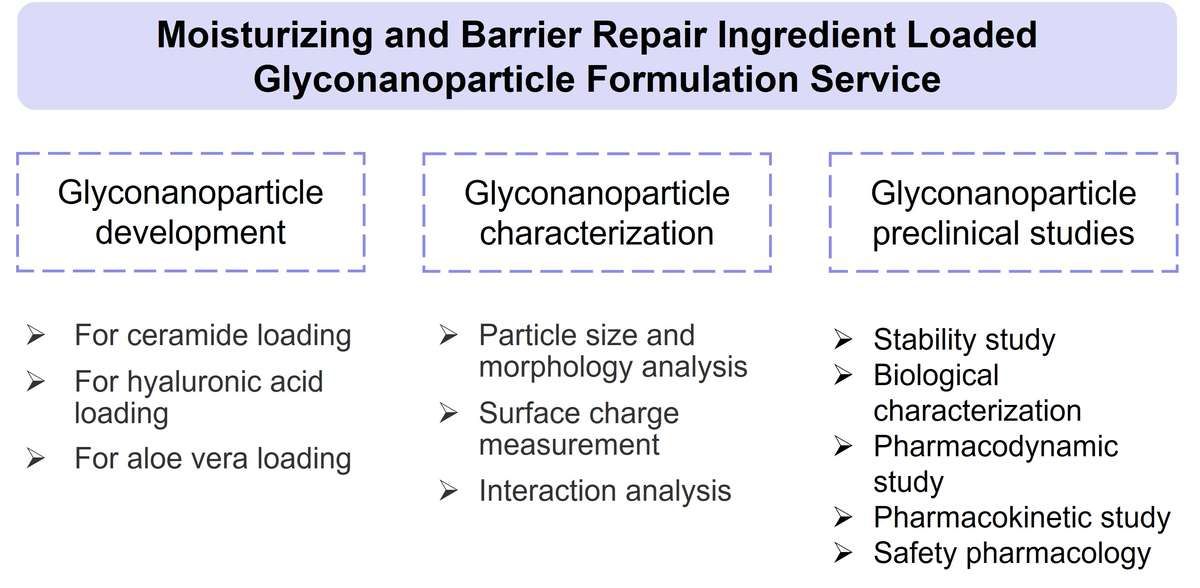
We specialize in the use of various nanotechnologies for low bioavailability and insoluble ingredients based on our GlycoNano™ Platform. There are more methods to synthesize glyconanoparticles, including Hydrogen Bonding-based Methods, Coulombic Interaction-based Methods, and so on. Afterward, we carry out detailed characterization and evaluation of the glyconanoparticle to ensure that it is suitable for the encapsulation of various actives. The specific service flow includes the following:
Development of Glyconanoparticle
Relying on cutting-edge technologies such as precipitation and click chemistry, our team of experts carefully designs the glyconanoparticle to ensure that its size, shape, and surface properties are tailored to the actual needs. A wide variety of glyconanoparticles are synthesized and offer orientation options for embedding small molecules, peptides, proteins, and other substances. By adjusting the formulation parameters, we achieve the desired active substance loading, release profile, and stability.
- Glyconanoparticle Formulation Service for Ceramide Loading
- Glyconanoparticle Formulation Service for Hyaluronic Acid Loading
- Glyconanoparticle Formulation Service for Aloe Vera Loading
Characterization of Glyconanoparticles
The particle size, surface charge, chemical composition, and structure of nanoparticles play a crucial role in nanoparticle aggregation, function, and interaction with biological systems. We combine a variety of cutting-edge technologies for the detailed characterization of physicochemical properties and comprehensive analysis of interactions of glyconanoparticles.
- Particle size and morphology analysis: Dynamic light scattering (DLS), transmission electron microscopy (TEM), etc., are used to accurately determine the particle size distribution and morphology of glyconanoparticles.
- Surface charge measurements: Surface charge has a significant effect on cellular uptake and stability. We evaluate the surface charge of glyconanoparticles by potentiometric analysis.
- Interaction analysis: DSL, surface plasmon resonance (SPR), and other technologies are used to detect the binding affinity of glyconanoparticles. In addition to this, interactions with peptides, proteins, etc., are also analyzed in detail.
Preclinical Studies of Glyconanoparticle
Preclinical studies of glyconanoparticles are a key step in advancing its application in cosmetics. We provide detailed studies including but not limited to the following:
- We accurately calculate the amount of active substance within the glyconanoparticle and the efficiency of the encapsulation process.
- In vitro, release assays are performed to gain insight into the rate and pattern of release of active substances from glyconanoparticles.
- Toxicity and Safety of glyconanoparticles are assessed by apoptosis assay, oxidative stress assay, proliferation assay, etc.
- We perform detailed studies on the Stability, cellular uptake, Pharmacodynamics, and Pharmacokinetics of glyconanoparticle formulation.
- The transdermal properties, skin barrier repair, and skin moisturizing properties of glyconanoparticle formulation are analyzed in detail.
Workflow
Our customized moisturizing and barrier repair ingredient-loaded glyconanoparticle formulation service provides tailored and scalable solutions based on the client's actual research needs. At the start of each project, we conduct an in-depth analysis of the feasibility of the study, including a thorough evaluation of the suitability of the glyconanoparticle for the specific active molecule. We also carefully analyze the physicochemical properties, solubility improvement, and stability evaluation to provide a solid foundation for subsequent development. Utilizing state-of-the-art analytical facilities and stringent quality control systems, we ensure that the quality of the glyconanoparticle obtained meets all requirements.
Applications
- In moisturizers, glyconanoparticle works by encapsulating the humectant, allowing it to better penetrate the skin and retain more water in the skin.
- In creams for repairing damaged skin, glyconanoparticles are used to encapsulate actives that are essential for restoring and maintaining the skin barrier.
- In wound care, etc., glyconanoparticle encapsulates active molecules that promote rapid wound healing and moisturization.
Advantages
- Our team of experienced and professional researchers provides customized solutions for moisturizing and barrier repair ingredient-loaded glyconanoparticle formulation based on client needs, driving innovation in the cosmetic field.
- We comprehensively analyze the glyconanoparticle before and after encapsulation, including morphology, size distribution, stability, and safety.
- The whole project follows a high standard control process and a perfect quality management system to ensure the high quality and stable effect of glyconanoparticle formulation.
Publication Data
Technology: Synthesis and characterization of nanoparticles
Journal: Discover Materials
IF: 4.225
Published: 2024
Results: In this paper, the advantages of nanoparticles for skin protection, their dynamic properties, types, synthesis methods, mathematical modeling, and preclinical studies (safety, in vivo toxicity, biodistribution, and other analyses) are presented in detail. The types of nanoparticles used for skin protection include solid lipid nanoparticles, gold nanoparticles, silver nanoparticles, etc., which offer the advantages of high stability, low cytotoxicity, and high biocompatibility. They are used to encapsulate various active ingredients to enhance the efficacy of cosmeceuticals and skin care products. As nanotechnology continues to advance, more nanoparticles will be developed to provide safe and effective means of skin protection.
Frequently Asked Questions
- What are the advantages of glyconanoparticles?
Glyconanoparticles offer several advantages over traditional delivery methods for encapsulating moisturizing and barrier repair ingredients:- Enhanced bioavailability: Glyconanoparticles significantly increase the solubility of insoluble substances, ensuring that they cross the biological barrier and increase absorption and utilization, enhancing effectiveness.
- Stability assurance: Glyconanoparticle effectively protects the active substance from environmental influences, avoiding early degradation and prolonging its active cycle.
- Multifunctionality: Glyconanoparticles are suitable for delivering a wide range of actives such as small molecules, peptides, and proteins.
- What types of glyconanoparticles do you develop?
We are engaged in the development of various types of glyconanoparticles, including Carbohydrate-based Nanoparticles, Gold Glyconanoparticles, Silver Glyconanoparticles, Magnetic Glyconanoparticles, etc., which offer a wide range of possibilities for the encapsulation and delivery of moisturizing and barrier repair ingredients. - What are the steps involved in your moisturizing and barrier repair ingredient-loaded glyconanoparticle formulation service?
- Initial communication and project planning
- Development and optimization of the glyconanoparticle
- Characterization (physicochemical properties and interactions)
- In vitro and in vivo preclinical studies
CD BioGlyco provides a one-stop moistening and barrier repair ingredient-loaded glyconanoparticle formulation service with an experienced team and advanced equipment. As an industry-leading glyconanoparticle researcher, we advance your moisturizing and barrier repair research throughout the development process from formulation to preclinical studies. Please feel free to contact us for any of your needs.
Reference
- Chakraborty, S.S.; et al. Advancements in nanoparticles for skin care: a comprehensive review of properties, applications, and future perspectives. Discover Materials. 2024, 4(1): 17.
Quick Links
Resources
- Glyco™ Synthesis Platform
- Custom Glycoprotein Synthesis
- Custom Glycoside Synthesis
- Custom Glycosyl Donor Synthesis
- Custom Thioglycoside Synthesis
- Custom Phosphatidylinositol Synthesis
- Custom Cyclodextrin Synthesis
- Custom Rhamnolipid Synthesis
- Custom Sphingolipid Synthesis
- Custom Building Block Synthesis
- Carbohydrate Manufacturing
- Synthesis Process Development and Optimization
- Custom Carbohydrate Synthesis
- Custom Glycolipid Synthesis
- Custom Glycopeptide Synthesis
- Custom Glycoconjugate Synthesis
- Custom Sugar-Nucleotide Synthesis
- Nucleoside & Nucleotide Synthesis Service
- Custom Oligonucleotide Synthesis Service
- Polynucleotide Synthesis Service
- Nucleoside & Nucleotide Modification Service
- Oligonucleotide Modification Service
- Nucleoside-based Production Service
- Nucleotide-based Production Service
- OPME-based NDP-sugar Synthesis Service
- OPME-based NMP-sugar Synthesis Service
- Glycomics Platform
- Glycoproteomics Platform
- N-Glycoproteomics of PDX Models
- Nanotechnologies for the Detection of Glycopeptides
- Glycoprotein Enrichment
- Glycoprotein Quantification
- Glyco-biomarker Detection Service
- Glyco-biomarker AFP Detection Service
- Glyco-biomarker CA19-9 Detection Service
- Glyco-biomarker CA125 Detection Service
- Glyco-biomarker CA15–3 Detection Service
- Glyco-biomarker CEA Detection Service
- Glyco-biomarker PSA Detection Service
- Glyco-biomarker Immunoglobulin G (IgG) Detection Service
- Glyco-biomarker Haptoglobin (Hp) Detection Service
- Glyco-biomarker α1-Antitrypsin (A1AT) Detection Service
- Glyco-biomarker α1-Acid Glycoprotein (AGP) Detection Service
- Glyco-biomarker Ceruloplasmin (CP) Detection Service
- Glyco-biomarker Fetuin A Detection Service
- Site Occupation
- Glycoprotein Structure Analysis
- Glycosylation Site-specific Antibody-Drug Conjugate (ADC) Development Platform
- Carbohydrate-based Glycomedicine Development Platform
- By Sources of Carbohydrate
- By Types of Carbohydrate
- Monosaccharides-based Glycomedicine Development
- Disaccharides-based Glycomedicine Development
- Trisaccharides-based Glycomedicine Development
- Oligosaccharides-based Glycomedicine Development
- Polysaccharides-based Glycomedicine Development
- Glycosides-based Glycomedicine Development
- Glycopeptide-based Glycomedicine Development
- Glycomimetic-based Glycomedicine Development
- By Applications of-based Glycomedicines
- Carbohydrate-based Anticoagulant Glycomedicine Development
- Carbohydrate-based Cardiovascular Glycomedicine Development
- Carbohydrate-based Antitumor Glycomedicine Development
- Carbohydrate-based Antidiabetic Glycomedicine Development
- Carbohydrate-based Antibacterial Glycomedicine Development
- Carbohydrate-based Antiviral Glycomedicines Development
- Carbohydrate-based Antiparasiti Glycomedicine Development
- By Discovery Strategies
- Glycoengineering-based Glycomedicine Development
- Production of Food Ingredients
- Multi-omics Platform for Cancer Glucose Metabolism (MOPCGM)
- Cancer Cell Glycolytic Analysis
- Cancer Cell TCA Cycle Analysis
- Cancer Cell PPP Analysis
- Gene-level Regulation Analysis of Cancer Glucose Metabolism
- Interplay Between Glucose Metabolism Reprogramming and Tumorigenesis & Progression
- Interplay Between Glucose Metabolism Reprogramming and Proliferative Signaling
- Interplay Between Glucose Metabolism Reprogramming and Growth Suppressor
- Interplay Between Glucose Metabolism Reprogramming and Cancer Cell Death
- Interplay Between Glucose Metabolism Reprogramming and Replicative Immortality
- Interplay Between Glucose Metabolism Reprogramming and Angiogenesis
- Interplay Between Glucose Metabolism Reprogramming and Invasion & Metastasis
- Interplay Between Glucose Metabolism Reprogramming and Immune Escape
- Interplay Between Glucose Metabolism Reprogramming and Genomic Instability
- Interplay Between Glucose Metabolism Reprogramming and Tumor-associated Inflammation
- Glucose Metabolism-Microenvironment Crosstalk Analysis in Cancer
- Cancer Glucose Metabolism In Vivo Analysis
- Applications of Studing Cancer Glucose Metabolism
- Discovery of Cancer Glucose Metabolism Small Molecule Inhibitor
- Discovery of Cancer Glucose Metabolism Therapeutic Monoclonal Antibodies
- Development of Gene Therapy Targeting Cancer Glucose Metabolism
- Discovery of Cancer Glucose Metabolism CAR-T Therapy Targeting
- Discovery of Cancer Glucose Metabolism Combination Therapy Strategy
- Discovery of Cancer Glucose Metabolism Precision Therapeutic Strategies
- Glycoengineering Platform
- Therapeutic Nucleic Acid Development Platform
- Therapeutic Oligonucleotide Synthesis Service
- siRNA Synthesis
- miRNA Synthesis
- ASO Synthesis
- Aptamer Synthesis
- PMO Synthesis
- sgRNA Synthesis
- Circular RNA Synthesis
- PNA Synthesis
- Lipid-based GalNac-RNA Delivery Service
- CpG Oligonucleotide Synthesis
- Click-based GalNac-RNA Delivery Service
- AntimiR Synthesis
- GalNAc-siRNA Delivery Service
- tRNA Synthesis
- GalNAc-ASO Delivery Service
- saRNA Synthesis
- Reporter Gene mRNA Synthesis
- Gene Editing mRNA Synthesis
- Gene Replacement mRNA Synthesis
- Cre Recombinase mRNA Synthesis
- hEPO mRNA Synthesis
- OVA mRNA Synthesis
- Therapeutic Oligonucleotide Modification Service
- Therapeutic Oligonucleotide Delivery Development Service
- Targeted Ligand and Linker Synthesis
- Monoantennary GalNac-RNA Delivery
- Biantennary GalNac-RNA Delivery
- Triantennary GalNac-RNA Delivery
- Tetra-antennary GalNac-RNA Delivery
- Solution Phase-based GalNac-RNA Delivery
- Solid Phase-based GalNac-RNA Delivery
- mRNA Poly(A) Tail Length Analysis
- GalNAc-siRNA Delivery
- GalNAc-ASO Delivery
- GalNAc-miRNA Delivery
- GalNAc-Aptamer Delivery
- GalNAc-AntimiR Delivery
- GalNAc-mRNA Delivery
- GalNAc-PNA Delivery
- Peptide-Therapeutic Oligonucleotide Delivery
- LNP-Therapeutic Oligonucleotide Delivery
- PEG-Therapeutic Oligonucleotide Delivery
- Biological Evaluation Service for Therapeutic Oligonucleotide
- mRNA-based Vaccine Development Service
- mRNA Sequence Design&Optimization Service
- mRNA Integrity Analysis ServicemRNA Integrity Analysis Service
- mRNA Biodistribution Analysis Service
- DNA Template Preparation Service
- mRNA Purity Analysis Service
- T Cell Cytokine Secretion Analysis Service
- mRNA Modification Service
- mRNA Length Analysis Service
- mRNA Purification Service
- Neutralizing Antibody Assay Service
- mRNA-LNP Formulation and Encapsulation Service
- mRNA Structural Characterization
- mRNA Structural Characterization Service
- mRNA Bioanalysis Service
- mRNA Residual DNA Template Analysis Service
- mRNA Residual Double-Stranded RNA (dsRNA) Analysis Service
- mRNA Size Analysis Service
- mRNA Polydispersity Analysis Service
- mRNA Zeta Potential Analysis Service
- mRNA Lipid Composition Analysis Service
- Oligonucleotide Drug Process and Formulation Development Service
- RNA Drug Process and Formulation Development
- Therapeutic Oligonucleotide Synthesis Service
- Glycobiology Microarray Platform
- Glyco™ Vaccine Development Platform
- Carbohydrate-based Vaccine Development
- Polysaccharide Vaccine Development
- Tumor-Associated Carbohydrate Vaccine Development
- Glycoconjugate Vaccine Development
- Natural Carbohydrate-based Vaccine Development
- Semi-synthetic Carbohydrate-based Vaccine Development
- Fully Synthetic Carbohydrate-based Vaccine Development
- Carbohydrate-based Antibacterial Vaccine Development
- Carbohydrate-based Antifungal Vaccine Development
- Carbohydrate-based Antiparasitic Vaccine Development
- Carbohydrate-based Antiviral Vaccine Development
- Carbohydrate-based Anticancer Vaccine Development
- Carbohydrate-based Antihelmintic Vaccine Development
- Monovalent Carbohydrate-based Vaccine Development
- Polyvalent Carbohydrate-based Vaccine Development
- Carrier Protein Design Service
- Carbohydrate Conjugation Service for Vaccine Development
- Carbohydrate-based Adjuvant Development
- Lipopolysaccharide-based Adjuvant Development
- Bacterial Outer Membrane Vesicles (OMVs)-based Adjuvant Development
- Trehalose Glycolipid-based Adjuvant Development
- Galactosylceramide-based Adjuvant Development
- Peptidoglycan-based Adjuvant Development
- Chitin/Chitosan-based Adjuvant Development
- Inulin-based Adjuvant Development
- Mannans-based Adjuvant Development
- Alginate-based Adjuvant Development
- Saponin-based Adjuvant Development
- α-Glucan-based Adjuvant Development
- Lentinan-based Adjuvant Development
- β-Glucans-based Adjuvant Development
- Deltin-based Adjuvant Development
- Muramyldipeptide-based Adjuvant Development
- Cord Factor-based Adjuvant Development
- Zwitterionic Polysaccharide-based Adjuvant Development
- Novel Plant Polysaccharides-based Adjuvant Development
- Glycoprotein-based Vaccine Development
- Glycopeptide-based Vaccine Development
- Carbohydrate-based Vaccine Development
- Glycogenomics Platform
- Glycogene Editing Service
- Glycogene Delivery Service
- Glycogene Expression Profiling
- Cancer Glycogene Discovery Service
- Glycogene Discovery Service in Cervical Cancer
- Glycogene Discovery Service in Leukemia
- Glycogene Discovery Service in Bladder Cancer
- Glycogene Discovery Service in Colorectal Adenocarcinoma
- Glycogene Discovery Service in Liver Cancer
- Glycogene Discovery Service in Lymphoma
- Glycogene Discovery Service in Breast Cancer
- Glycogene Discovery Service in Prostate Cancer
- Glycogene Discovery Service in Pancreatic Cancer
- Glycogene Discovery Service in Lung Cancer
- Glycogene Discovery Service in Thyroid Cancer
- Glycogene Discovery Service in Ovarian Cancer
- Glycan Display Platform
- Traditional Glycan Display Array
- Natural Oligosaccharide Library Construction Service
- Chemical Synthesis-based Oligosaccharide Library Construction Service
- Enzymatic Synthesis-based Oligosaccharide Library Construction Service
- Modular Synthesis-based Oligosaccharide Library Construction Service
- Oligosaccharide Library Immobilization Service
- Cell-based Glycan Display Array
- Neoglycolipid (NGL) Display Array
- Liquid Glycan Display Array (LiGA)
- Glycophage Display
- N-linked Glycoprotein-based Glycophage Display System Construction Service
- O-linked Glycoprotein-based Glycophage Display System Construction Service
- Glycophage Display-based Glycosylase Genetic Analysis Service
- Glycophag Display-based Glycoarray Service
- Glycophage Display-based Antibody Development Service
- Glycophage Display-based Epitope Mapping Service
- Glycophage Display-based Biomarker Development Service
- De Novo Glycan Display
- Cell-Surface Glycan Editing
- Examining the Effects of Altering Blood Group Antigens on Erythrocyte Cell Surfaces
- Preventing Cellular Rejection During Transplantation
- Modulating Chemical Composition and Physical Parameters of Glycocalyx
- Tailoring Cell Membranes with Biologically Active Glycans
- Targeting Glycosaminoglycan-mediated Growth Factor Signaling to Influence Stem Cell Specification
- Long-term De Novo Glycan Display for Directing Stem Cell Fate
- Traditional Glycan Display Array
- GlycoNano™ Platform
- Glyconanoparticle Development Service
- Techniques for Glyconanoparticle Development
- Carbohydrate-based Nanoparticle Production
- Gold Glyconanoparticle Production
- Silver Glyconanoparticle
- Magnetic Glyconanoparticle
- Quantum Dot (QD) Glyconanoparticle
- Glyconanoparticle Characterization
- PEG Glyconanoparticle
- Carbon-based Glyconanoparticle
- Fluorescent Glyconanoparticle
- Silica Glyconanoparticle
- Liposome Glyconanoparticle
- Glycol Nanohydrogel Development
- Glycol Nanorod
- Glycol Nanotube
- Glycol Nanocrystal/Nanosheet/Nanosphere/Nanofiber
- Glyconanoparticle Preclinical Study
- Glyconanoparticle Formulation
- Glyconanotechnology-based Biosensor Development
- GlycoNano™ Bioink Production for 3D Printing
- Glyconanoparticle Development Service
- Glyco™ Synthesis Platform


