Natural Polymer-based Glycol Nanohydrogel Production Service
Advantages of Natural Polymers in Hydrogel Preparation
Natural polymers are obtained from nature and have the advantages of good biocompatibility, degradability, and environmental friendliness. They are ideal skeletons for making hydrogels. Hydrogels developed based on natural polymers have received extensive attention in biomedical fields such as drug delivery, wound healing, and regenerative medicine. At CD BioGlyco, we use advanced technology to provide high-quality, customized nanohydrogel production services to scientific researchers and enterprises to meet the unique needs of our clients.
Fig.1 Overview of natural polymer-based hydrogels. (Zhao, et al., 2023)
Transforming Tomorrow of Biomedicine: Natural Polymers-based Nanohydrogels
Our GlycoNano™ Platform integrates advanced synthesis technology, precise characterization methods, and perfect activity analysis methods to provide clients with one-stop services from raw material selection to product delivery. Nanohydrogels occupy an important position in the biomedical field. We provide clients with Natural Polymer-based Nanohydrogel Production Services and Synthetic Polymer-based Nanohydrogel Production Services. Commonly used technologies include but are not limited to:
Microtemplate-assisted Polymerization
Precipitation/Crosslinking
Emulsion/Crosslinking
Self-assembly/Crosslinking
Microtemplating/Crosslinking
Natural polymer-based nanohydrogels derived from natural materials have attracted wide attention due to their applications in pharmaceuticals, agriculture, medicine, tissue engineering, cancer treatment, and drug delivery. Natural polymers used for hydrogel manufacturing include gelatin, cellulose, chitosan, dextran, alginate, hyaluronic acid, and its derivatives. These polymers are used to construct engineered nanohydrogels through strategies such as ionic interactions, physical crosslinking, and chemical crosslinking. Here, we provide clients with a variety of production services for polymer nano hydrogels based on natural sources. Our services are as follows:
Carbohydrate-based Nanohydrogel Production
We exploit the unique properties of carbohydrates to develop and produce a wide range of nanohydrogel materials for applications such as drug delivery, tissue engineering, and wound healing. Our cutting-edge technologies and characterization methods ensure precise control of the size, structure, and functionality of nanohydrogels to meet specific clients' needs and industry standards.
- Chondroitin
- Pullulan
- Chitosan
- Alginate
- Dextran
- Agarose
- Pectin
- Starch
- Xanthan Gum
- Cellulose
- Carrageenan
- Cyclodextrin
- Gellan Gum
Glycosaminoglycan-based Nanohydrogel Production
Glycosaminoglycans provide nanohydrogels with enhanced properties such as improved moisture retention, bioactivity, and mechanical stability. These properties make our glycosaminoglycan-based nanohydrogels potentially advantageous in skin care, regenerative medicine, and pharmaceutical applications.
- Chondroitin sulfate
- Heparin
- Dermatan Sulfate
- Hyaluronic acid
Polypeptide/Glycoprotein-based Nanohydrogel Production
Peptides and glycoproteins have inherent bioactivity, specificity, and biocompatibility. Our peptide- and glycoprotein-based nanohydrogels are carefully designed to promote targeted drug delivery, cell adhesion, and controlled release, among others.
- Collagen
- Gelatin
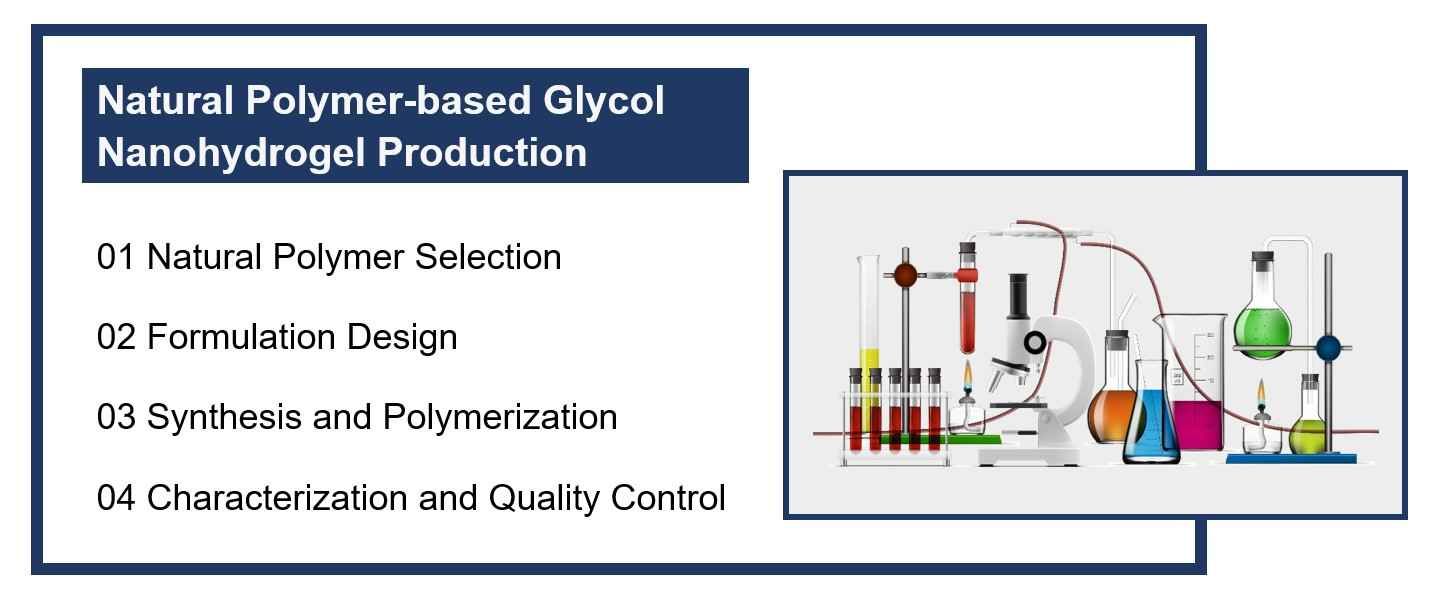
Natural Polymer Selection
Engage with the clients to understand the specific requirements, including the intended application of the nanohydrogel, parameter requirements, etc. to define the scope, composition, and properties required for the final product. Select the appropriate natural polymer, which may include alginate, chitosan, protein, or other biocompatible materials.
Formulation Design
Designing the precise formulation of the nanohydrogel involves determining the ratio of each component and the conditions required for synthesis to ensure that the hydrogel meets the necessary mechanical and biological properties.
Synthesis and Polymerization
Depending on the characteristics of the polymer, strategies such as emulsion polymerization, nanoprecipitation, self-assembly, physical cross-linking, or chemical cross-linking are used to synthesize the nanohydrogel. After synthesis, the nanohydrogel is purified to remove any unreacted materials or by-products.
Characterization and Quality Control
The nanohydrogel is rigorously tested to evaluate its structure, size, morphology, mechanical properties, and functionality to ensure that the product meets all specified standards.
Workflow
Applications
- Due to its excellent biocompatibility and non-toxic properties, natural polymer-based nanohydrogels are used in drug delivery systems to achieve precise and controlled release of drugs.
- Natural polymer hydrogels have shown significant efficacy as soil water retention agents, effectively improving the soil's water storage capacity and reducing the frequency of irrigation.
- Natural polymer nanohydrogels are used in pollution treatment systems to effectively absorb oil spills and heavy metal pollutants in water bodies, reducing the risk of environmental pollution.
Advantages
- Whether it is used in medicine, agriculture, or environmental protection, our team of experts will design and produce the most suitable nanohydrogel products according to the unique requirements of clients.
- We use biodegradable materials to ensure the environmental friendliness of the products and minimize the impact on the environment.
- Our services cover every step from natural material selection to post-production. Whether you encounter any problems during use or need professional advice, our professional technical team will provide you with timely and comprehensive support.
Publication Data
DOI: 10.1038/s41598-020-80133-3
Journal: Scientific Reports
Published: 2021
IF: 3.8
Results: A novel nanobiocomposite scaffold CTT-CS/SF/Mg(OH)2 was synthesized by modifying cross-linked terephthaloyl thiourea-chitosan (CTT-CS) hydrogel with silk fibroin (SF) and Mg(OH)2. Then its cytotoxicity, antimicrobial activity, and biocompatibility were evaluated. The formation and presence of new chemical bonds and functional groups were determined by Fourier transform infrared (FTIR). Structural elements were identified by energy-dispersive X-ray spectroscopy (EDX). Different structural morphologies in each synthesis step were revealed by the field-emission scanning microscope (FE-SEM), and the thermogravimetric behavior of the nanobiocomposite scaffold was studied by thermogravimetric analysis.
Fig.2 Synthesis preparation of CTT-CS/SF/Mg(OH)2 nanobiocomposite scafold. (Eivazzadeh-Keihan, et al., 2021)
Frequently Asked Questions
- Which techniques are used to identify natural polymer-based nanohydrogel?
Nuclear magnetic resonance (NMR) determines the chemical structure of the hydrogel molecules. FTIR spectroscopy identifies the functional groups and understands the chemical bonds present in the material. SEM analyzes detailed images of its surface topography and morphology. Transmission electron microscopy (TEM) visualizes the internal structure and size of the nanoparticles within the hydrogel matrix. -
What technical support do you offer during and after the production process?
We provide comprehensive technical support from the initial natural material selection to scheme design, synthesis optimization, product characterization, and performance testing to ensure high-quality results. Our technicians will also help solve any questions or concerns you may have during use.
CD BioGlyco integrates advanced synthesis technology, sophisticated characterization methods, and comprehensive performance testing to provide clients with highly customized nanohydrogel production services. Please feel free to contact us to discuss detailed experimental plans.
References
- Zhao, L.; et al. Natural polymer-based hydrogels: From polymer to biomedical applications. Pharmaceutic. 2023, 15(10): 2514.
- Eivazzadeh-Keihan, R.; et al. Chitosan hydrogel/silk fibroin/Mg (OH)2 nanobiocomposite as a novel scaffold with antimicrobial activity and improved mechanical properties. Scientific Report. 2021, 11(1): 650.
Quick Links
Resources
- Glyco™ Synthesis Platform
- Custom Glycoprotein Synthesis
- Custom Glycoside Synthesis
- Custom Glycosyl Donor Synthesis
- Custom Thioglycoside Synthesis
- Custom Phosphatidylinositol Synthesis
- Custom Cyclodextrin Synthesis
- Custom Rhamnolipid Synthesis
- Custom Sphingolipid Synthesis
- Custom Building Block Synthesis
- Carbohydrate Manufacturing
- Synthesis Process Development and Optimization
- Custom Carbohydrate Synthesis
- Custom Glycolipid Synthesis
- Custom Glycopeptide Synthesis
- Custom Glycoconjugate Synthesis
- Custom Sugar-Nucleotide Synthesis
- Nucleoside & Nucleotide Synthesis Service
- Custom Oligonucleotide Synthesis Service
- Polynucleotide Synthesis Service
- Nucleoside & Nucleotide Modification Service
- Oligonucleotide Modification Service
- Nucleoside-based Production Service
- Nucleotide-based Production Service
- OPME-based NDP-sugar Synthesis Service
- OPME-based NMP-sugar Synthesis Service
- Glycomics Platform
- Glycoproteomics Platform
- N-Glycoproteomics of PDX Models
- Nanotechnologies for the Detection of Glycopeptides
- Glycoprotein Enrichment
- Glycoprotein Quantification
- Glyco-biomarker Detection Service
- Glyco-biomarker AFP Detection Service
- Glyco-biomarker CA19-9 Detection Service
- Glyco-biomarker CA125 Detection Service
- Glyco-biomarker CA15–3 Detection Service
- Glyco-biomarker CEA Detection Service
- Glyco-biomarker PSA Detection Service
- Glyco-biomarker Immunoglobulin G (IgG) Detection Service
- Glyco-biomarker Haptoglobin (Hp) Detection Service
- Glyco-biomarker α1-Antitrypsin (A1AT) Detection Service
- Glyco-biomarker α1-Acid Glycoprotein (AGP) Detection Service
- Glyco-biomarker Ceruloplasmin (CP) Detection Service
- Glyco-biomarker Fetuin A Detection Service
- Site Occupation
- Glycoprotein Structure Analysis
- Glycosylation Site-specific Antibody-Drug Conjugate (ADC) Development Platform
- Carbohydrate-based Glycomedicine Development Platform
- By Sources of Carbohydrate
- By Types of Carbohydrate
- Monosaccharides-based Glycomedicine Development
- Disaccharides-based Glycomedicine Development
- Trisaccharides-based Glycomedicine Development
- Oligosaccharides-based Glycomedicine Development
- Polysaccharides-based Glycomedicine Development
- Glycosides-based Glycomedicine Development
- Glycopeptide-based Glycomedicine Development
- Glycomimetic-based Glycomedicine Development
- By Applications of-based Glycomedicines
- Carbohydrate-based Anticoagulant Glycomedicine Development
- Carbohydrate-based Cardiovascular Glycomedicine Development
- Carbohydrate-based Antitumor Glycomedicine Development
- Carbohydrate-based Antidiabetic Glycomedicine Development
- Carbohydrate-based Antibacterial Glycomedicine Development
- Carbohydrate-based Antiviral Glycomedicines Development
- Carbohydrate-based Antiparasiti Glycomedicine Development
- By Discovery Strategies
- Glycoengineering-based Glycomedicine Development
- Production of Food Ingredients
- Multi-omics Platform for Cancer Glucose Metabolism (MOPCGM)
- Cancer Cell Glycolytic Analysis
- Cancer Cell TCA Cycle Analysis
- Cancer Cell PPP Analysis
- Gene-level Regulation Analysis of Cancer Glucose Metabolism
- Interplay Between Glucose Metabolism Reprogramming and Tumorigenesis & Progression
- Interplay Between Glucose Metabolism Reprogramming and Proliferative Signaling
- Interplay Between Glucose Metabolism Reprogramming and Growth Suppressor
- Interplay Between Glucose Metabolism Reprogramming and Cancer Cell Death
- Interplay Between Glucose Metabolism Reprogramming and Replicative Immortality
- Interplay Between Glucose Metabolism Reprogramming and Angiogenesis
- Interplay Between Glucose Metabolism Reprogramming and Invasion & Metastasis
- Interplay Between Glucose Metabolism Reprogramming and Immune Escape
- Interplay Between Glucose Metabolism Reprogramming and Genomic Instability
- Interplay Between Glucose Metabolism Reprogramming and Tumor-associated Inflammation
- Glucose Metabolism-Microenvironment Crosstalk Analysis in Cancer
- Cancer Glucose Metabolism In Vivo Analysis
- Applications of Studing Cancer Glucose Metabolism
- Discovery of Cancer Glucose Metabolism Small Molecule Inhibitor
- Discovery of Cancer Glucose Metabolism Therapeutic Monoclonal Antibodies
- Development of Gene Therapy Targeting Cancer Glucose Metabolism
- Discovery of Cancer Glucose Metabolism CAR-T Therapy Targeting
- Discovery of Cancer Glucose Metabolism Combination Therapy Strategy
- Discovery of Cancer Glucose Metabolism Precision Therapeutic Strategies
- Glycoengineering Platform
- Therapeutic Nucleic Acid Development Platform
- Therapeutic Oligonucleotide Synthesis Service
- siRNA Synthesis
- miRNA Synthesis
- ASO Synthesis
- Aptamer Synthesis
- PMO Synthesis
- sgRNA Synthesis
- Circular RNA Synthesis
- PNA Synthesis
- Lipid-based GalNac-RNA Delivery Service
- CpG Oligonucleotide Synthesis
- Click-based GalNac-RNA Delivery Service
- AntimiR Synthesis
- GalNAc-siRNA Delivery Service
- tRNA Synthesis
- GalNAc-ASO Delivery Service
- saRNA Synthesis
- Reporter Gene mRNA Synthesis
- Gene Editing mRNA Synthesis
- Gene Replacement mRNA Synthesis
- Cre Recombinase mRNA Synthesis
- hEPO mRNA Synthesis
- OVA mRNA Synthesis
- Therapeutic Oligonucleotide Modification Service
- Therapeutic Oligonucleotide Delivery Development Service
- Targeted Ligand and Linker Synthesis
- Monoantennary GalNac-RNA Delivery
- Biantennary GalNac-RNA Delivery
- Triantennary GalNac-RNA Delivery
- Tetra-antennary GalNac-RNA Delivery
- Solution Phase-based GalNac-RNA Delivery
- Solid Phase-based GalNac-RNA Delivery
- mRNA Poly(A) Tail Length Analysis
- GalNAc-siRNA Delivery
- GalNAc-ASO Delivery
- GalNAc-miRNA Delivery
- GalNAc-Aptamer Delivery
- GalNAc-AntimiR Delivery
- GalNAc-mRNA Delivery
- GalNAc-PNA Delivery
- Peptide-Therapeutic Oligonucleotide Delivery
- LNP-Therapeutic Oligonucleotide Delivery
- PEG-Therapeutic Oligonucleotide Delivery
- Biological Evaluation Service for Therapeutic Oligonucleotide
- mRNA-based Vaccine Development Service
- mRNA Sequence Design&Optimization Service
- mRNA Integrity Analysis ServicemRNA Integrity Analysis Service
- mRNA Biodistribution Analysis Service
- DNA Template Preparation Service
- mRNA Purity Analysis Service
- T Cell Cytokine Secretion Analysis Service
- mRNA Modification Service
- mRNA Length Analysis Service
- mRNA Purification Service
- Neutralizing Antibody Assay Service
- mRNA-LNP Formulation and Encapsulation Service
- mRNA Structural Characterization
- mRNA Structural Characterization Service
- mRNA Bioanalysis Service
- mRNA Residual DNA Template Analysis Service
- mRNA Residual Double-Stranded RNA (dsRNA) Analysis Service
- mRNA Size Analysis Service
- mRNA Polydispersity Analysis Service
- mRNA Zeta Potential Analysis Service
- mRNA Lipid Composition Analysis Service
- Oligonucleotide Drug Process and Formulation Development Service
- RNA Drug Process and Formulation Development
- Therapeutic Oligonucleotide Synthesis Service
- Glycobiology Microarray Platform
- Glyco™ Vaccine Development Platform
- Carbohydrate-based Vaccine Development
- Polysaccharide Vaccine Development
- Tumor-Associated Carbohydrate Vaccine Development
- Glycoconjugate Vaccine Development
- Natural Carbohydrate-based Vaccine Development
- Semi-synthetic Carbohydrate-based Vaccine Development
- Fully Synthetic Carbohydrate-based Vaccine Development
- Carbohydrate-based Antibacterial Vaccine Development
- Carbohydrate-based Antifungal Vaccine Development
- Carbohydrate-based Antiparasitic Vaccine Development
- Carbohydrate-based Antiviral Vaccine Development
- Carbohydrate-based Anticancer Vaccine Development
- Carbohydrate-based Antihelmintic Vaccine Development
- Monovalent Carbohydrate-based Vaccine Development
- Polyvalent Carbohydrate-based Vaccine Development
- Carrier Protein Design Service
- Carbohydrate Conjugation Service for Vaccine Development
- Carbohydrate-based Adjuvant Development
- Lipopolysaccharide-based Adjuvant Development
- Bacterial Outer Membrane Vesicles (OMVs)-based Adjuvant Development
- Trehalose Glycolipid-based Adjuvant Development
- Galactosylceramide-based Adjuvant Development
- Peptidoglycan-based Adjuvant Development
- Chitin/Chitosan-based Adjuvant Development
- Inulin-based Adjuvant Development
- Mannans-based Adjuvant Development
- Alginate-based Adjuvant Development
- Saponin-based Adjuvant Development
- α-Glucan-based Adjuvant Development
- Lentinan-based Adjuvant Development
- β-Glucans-based Adjuvant Development
- Deltin-based Adjuvant Development
- Muramyldipeptide-based Adjuvant Development
- Cord Factor-based Adjuvant Development
- Zwitterionic Polysaccharide-based Adjuvant Development
- Novel Plant Polysaccharides-based Adjuvant Development
- Glycoprotein-based Vaccine Development
- Glycopeptide-based Vaccine Development
- Carbohydrate-based Vaccine Development
- Glycogenomics Platform
- Glycogene Editing Service
- Glycogene Delivery Service
- Glycogene Expression Profiling
- Cancer Glycogene Discovery Service
- Glycogene Discovery Service in Cervical Cancer
- Glycogene Discovery Service in Leukemia
- Glycogene Discovery Service in Bladder Cancer
- Glycogene Discovery Service in Colorectal Adenocarcinoma
- Glycogene Discovery Service in Liver Cancer
- Glycogene Discovery Service in Lymphoma
- Glycogene Discovery Service in Breast Cancer
- Glycogene Discovery Service in Prostate Cancer
- Glycogene Discovery Service in Pancreatic Cancer
- Glycogene Discovery Service in Lung Cancer
- Glycogene Discovery Service in Thyroid Cancer
- Glycogene Discovery Service in Ovarian Cancer
- Glycan Display Platform
- Traditional Glycan Display Array
- Natural Oligosaccharide Library Construction Service
- Chemical Synthesis-based Oligosaccharide Library Construction Service
- Enzymatic Synthesis-based Oligosaccharide Library Construction Service
- Modular Synthesis-based Oligosaccharide Library Construction Service
- Oligosaccharide Library Immobilization Service
- Cell-based Glycan Display Array
- Neoglycolipid (NGL) Display Array
- Liquid Glycan Display Array (LiGA)
- Glycophage Display
- N-linked Glycoprotein-based Glycophage Display System Construction Service
- O-linked Glycoprotein-based Glycophage Display System Construction Service
- Glycophage Display-based Glycosylase Genetic Analysis Service
- Glycophag Display-based Glycoarray Service
- Glycophage Display-based Antibody Development Service
- Glycophage Display-based Epitope Mapping Service
- Glycophage Display-based Biomarker Development Service
- De Novo Glycan Display
- Cell-Surface Glycan Editing
- Examining the Effects of Altering Blood Group Antigens on Erythrocyte Cell Surfaces
- Preventing Cellular Rejection During Transplantation
- Modulating Chemical Composition and Physical Parameters of Glycocalyx
- Tailoring Cell Membranes with Biologically Active Glycans
- Targeting Glycosaminoglycan-mediated Growth Factor Signaling to Influence Stem Cell Specification
- Long-term De Novo Glycan Display for Directing Stem Cell Fate
- Traditional Glycan Display Array
- GlycoNano™ Platform
- Glyconanoparticle Development Service
- Techniques for Glyconanoparticle Development
- Carbohydrate-based Nanoparticle Production
- Gold Glyconanoparticle Production
- Silver Glyconanoparticle
- Magnetic Glyconanoparticle
- Quantum Dot (QD) Glyconanoparticle
- Glyconanoparticle Characterization
- PEG Glyconanoparticle
- Carbon-based Glyconanoparticle
- Fluorescent Glyconanoparticle
- Silica Glyconanoparticle
- Liposome Glyconanoparticle
- Glycol Nanohydrogel Development
- Glycol Nanorod
- Glycol Nanotube
- Glycol Nanocrystal/Nanosheet/Nanosphere/Nanofiber
- Glyconanoparticle Preclinical Study
- Glyconanoparticle Formulation
- Glyconanotechnology-based Biosensor Development
- GlycoNano™ Bioink Production for 3D Printing
- Glyconanoparticle Development Service
- Glyco™ Synthesis Platform


