


Protein Prospector Achieves a New Breakthrough in Glycopeptide Identification
January 22, 2026In glycobiology and Glycoproteomics Research, accurately deciphering the microheterogeneity of Glycosylation Modifications, i.e., identifying the specific glycopeptides (peptide segment + glycan chain) attached to glycoproteins, is crucial for understanding their function. However, due to the complex structure of glycan chains, their propensity to form adducts, and their unique mass spectrometry fragmentation behavior, glycopeptide data analysis has long been a recognized technical bottleneck.
Although several glycopeptide analysis software programs have emerged in recent years, they still differ in their identification depth, reliability, and ability to handle complex situations. Recently, Protein Prospector, a long-standing software with a 30-year history, has demonstrated significant advantages in glycopeptide identification through a series of innovative improvements.
A study published in Molecular & Cellular Proteomics in February 2025, titled "Improving the Depth and Reliability of Glycopeptide Identification Using Protein Prospector," showed that Protein Prospector can identify a significantly greater number of glycopeptide spectra and glycan types from the same dataset than other software, and can correct a large number of misassignments by considering glycan adducts. This research provides us with a powerful new tool and important insights for selecting and analyzing glycopeptide data.
Glycopeptide Analysis: Why Is It So Difficult?
Glycosylation is the most common and diverse post-translational modification of proteins. In mammals, N-glycosylation is easier to analyze than O-glycosylation due to its defined sequence motif, conserved core pentasaccharide structure, and relatively stable glycosidic bond, but its complexity should not be underestimated.
The main challenges include:
- Glycan Chain Diversity: Even the same glycosylation site can be linked to dozens or even hundreds of different glycan structures (glycoforms).
- Fragmentation Complexity: In collision-induced dissociation, both the glycan chain and the peptide backbone fragment simultaneously, producing a mixture of ions from two fragmentation pathways, making spectral interpretation difficult.
- Adduct Interference: Glycopeptides are particularly prone to forming adducts with ammonium salts, metal ions, etc., leading to shifts in precursor ion mass and easily causing misidentification.
- Background Noise: In glycopeptide-enriched samples, even if the target ion is not a glycopeptide, characteristic fragment ions of glycan chains (such as m/z 204) from co-fragmentation or background noise are often detected, misleading the analysis software.
Protein Prospector's Innovative Three-Step Workflow
The core breakthrough of Protein Prospector lies in its optimized glycopeptide analysis process, which is not a simple database search, but a layered, mutually verifying three-step strategy:
Step 1: Spectral Filtering and Preliminary Identification
Using its MS-Filter module, it first filters out all mass spectra containing characteristic fragment ions of N-acetylhexosamine (m/z 204.087), greatly reducing the search scope.
Then, using the main search engine Batch-Tag, a peptide-centric database search is performed in a database containing 730 mammalian N-glycans. This stage primarily relies on peptide backbone fragment ions to identify peptide sequences, and glycan assignment is based solely on mass shift.
Step 2: High-Confidence Glycopeptide List Generation
The results from the first step are rigorously filtered in Search Compare with a 1% false discovery rate to obtain a high-confidence list of core glycopeptides (peptide + glycan type).
Step 3: Glycan Type Expansion and Validation Based on Y1 Ions
This is the most crucial innovative step. The software uses the core peptide list obtained in the previous step to run MS-Filter again, searching for the corresponding Y1 ions of these peptides in the entire dataset.
The Y1 ion is a peptide ion that retains a core GlcNAc after glycopeptide fragmentation, and its mass is equal to "peptide mass + 203.08 Da". Finding the Y1 ion means finding another possible glycopeptide variant of that peptide carrying a different glycan chain.
For each candidate spectrum found, the software not only confirms the Y1 ion but also systematically scores the glycan fragment ions, evaluating the match between the observed B/Y ions and the hypothetical glycan structure, thus selecting the most likely one from multiple candidate glycan types.
This strategy of first locking onto the peptide and then using it as an anchor to search for more glycan types cleverly bypasses the difficulty of directly identifying all complex spectra from scratch, greatly improving identification sensitivity and efficiency.
Performance Showdown: Protein Prospector Demonstrates Clear Advantages
To objectively evaluate performance, researchers used a publicly available Mass Spectrometry dataset of mouse liver glycopeptides and conducted a comparative analysis using six mainstream software programs (Byonic, GlycoDecipher, MSFragger, pGlyco3, Protein Prospector, StrucGP).
The results were impressive:
- Number of Spectra Identified: Without considering adducts, Protein Prospector identified 41,787 glycopeptide spectra, approximately 50% more than the second-best software. When ammonium and iron adducts were considered, the number of identified spectra jumped to 58,023, more than double that of other software.
- Number of Unique Glycoforms: Protein Prospector reported 6,373 unique peptide-glycan combinations, 70% more than the second-best software. This indicates that it discovered more new glycoform variants on known peptides.
- Number of Glycosylation Sites: The number of glycosylated peptide sequences discovered by each software did not differ significantly (approximately 900-1,038). This shows that Protein Prospector's advantage lies primarily in revealing the complexity of glycoforms at each site more thoroughly, reporting an average of about 6 glycoforms per site, while other software only reported 3-4.
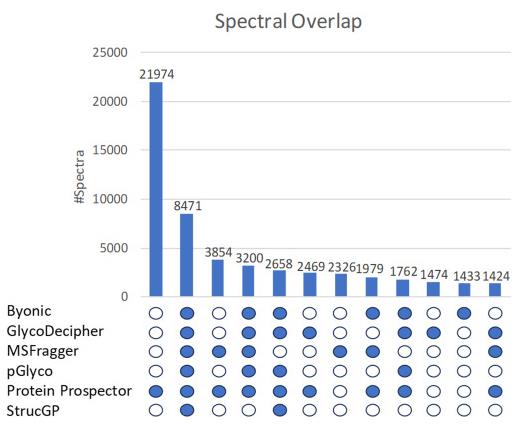
Fig. 1 Overlap of spectral identification results from six glycopeptide analysis software programs on a mouse liver dataset. (Chalkley, et al. 2025)
Key Insights: Considering Adducts Corrects Numerous Errors
Adducts, particularly ammonium adducts, are an easily overlooked yet significantly impactful factor in glycopeptide analysis. This study reveals the dual role of considering adducts:
- Discovery of Genuinely Existing Adduct Spectra: Protein Prospector identified over 12,000 glycopeptide spectra with ammonium adducts. These spectra would be completely missed in searches that ignore adducts.
- Correction of Previously Erroneous Assignments: More importantly, allowing for ammonium adducts directly corrects a large number of previously incorrect glycan assignments. For example, in MSFragger software, 1,254 spectra (4.5% of the original results) were originally incorrectly assigned to a complex type disialylated glycan (HexNAc4Hex3NeuAc2). When ammonium adducts were allowed in the search, they were correctly reassigned as ammonium adducts of High-Mannose Glycans (HexNAc2Hex9). The mass difference between the two is only 0.994 Da, making them easily confused even at high mass accuracy. This correction significantly improves the overall reliability of the results.
Remaining Challenges: Background Fragments and Software Strategy Selection
The study also highlights common challenges in current analyses.
Background glycan fragment ions are ubiquitous. Even in glycopeptide spectra identified as not containing NeuGc (N-glycolylneuraminic acid), over 70% showed characteristic NeuGc fragment ions (m/z 290, 308). This is not due to the presence of NeuGc in the glycan, but rather from co-isolation or background interference. This requires analytical software with strong interference-resistant scoring capabilities.
Peptide-first and glycan-first strategies each have their advantages.
- Peptide-First Strategy: More advantageous when the peptide backbone fragmentation is good, but the glycan Y-ion series is incomplete (e.g., only Y0 and Y1 ions).
- Glycan-First Strategy: More sensitive when glycan fragments are abundant but peptide fragments are scarce, as it limits the search range (only searching for peptides containing N-glycosylation motifs).
- Protein Prospector's three-step method can be seen as a powerful complement to the traditional peptide-first strategy. Through the Y1 ion as a bridge, it compensates for the over-reliance on complete glycan fragment information in discovering new glycan types.
Summary and Outlook
This study confirms that Protein Prospector, through its unique three-step analysis process, particularly the glycan extension search based on Y1 ions, can extract deeper and broader glycopeptide information from complex data.
The implications for glycoproteomics researchers are:
- Tool Selection: For studies aiming for maximum identification depth, especially those seeking to comprehensively reveal the microheterogeneity of glycan types at each glycosylation site, Protein Prospector is a powerful candidate tool.
- Parameter Settings: Including glycan adducts (especially ammonium salts) in the search is no longer optional, but a necessary step to improve identification accuracy and coverage.
- Result Review: FDR estimates from all software may be inaccurate in glycopeptide analysis. Manual review of key spectra and cross-validation using the spectral annotation features provided by the software are crucial for ensuring high-quality findings.
In the future, as the software further integrates glycan topological structure inference functions and continuously optimizes algorithms for handling background noise and adducts, we expect to extract more accurate and complete glycosylation information from valuable mass spectrometry data, thereby revealing the mysteries of glycobiology in health and disease in greater depth.
Related Services & Products
- N-Glycoproteomics of PDX Models
- Nanotechnologies for the Detection of Glycopeptides
- Glycoprotein Enrichment
- Glycoprotein Quantification
- Glyco-biomarker Detection Service
- Site Occupation
- Glycoprotein Structure Analysis
- Custom Glycosylation of Proteins
- Custom Glycosylation of Antibodies
- Custom Glycosylation of Cell Membranes
- Custom Glycosylation of Bacteria Membranes
- Custom Glycopeptide Synthesis
- Glycopeptides
Reference
- Chalkley, R. J., & Baker, P. R. (2025). Improving the Depth and Reliability of Glycopeptide Identification Using Protein Prospector. Molecular & Cellular Proteomics, 24(2). DOI: 1016/j.mcpro.2025.100903.


