


SUGA: A Novel High-Throughput, Label-Free Method for Rapid Glycan Analysis
January 17, 2026On February 20, 2025, a team led by Richard D. Cummings from Harvard Medical School published a study in the Journal of Proteome Research titled "Swift Universal Glycan Acquisition (SUGA) Enables Quantitative Glycan Profiling across Diverse Sample Types," introducing a novel Glycomics Analysis method called Swift Universal Glycan Acquisition (SUGA), which enables rapid, high-throughput, and label-free glycan analysis and quantification.
Research Background and Significance
Glycans are complex biomolecules composed of Monosaccharides linked by glycosidic bonds. They combine with proteins or lipids to form glycoproteins or glycolipids. Glycosylation plays a crucial role in almost all life processes, including cell recognition, signal transduction, and immune response. Abnormal Glycosylation is closely associated with cancer, autoimmune diseases, and infectious diseases.
Therefore, comprehensively and rapidly analyzing the glycan composition in biological samples is crucial for understanding disease mechanisms and developing new biomarkers or drugs.
Current mainstream Glycan Mass Spectrometry Analysis workflows typically include: enzymatic release of glycans from glycoproteins, reduction (opening the reducing end cyclic structure), derivatization (such as methylation to improve ionization efficiency or attachment of fluorescent labels), liquid chromatography separation, and finally mass spectrometry detection.
These steps are not only time-consuming (up to several hours per sample), but the complex chemical processing may introduce bias or lead to the loss of some fragile glycans (such as sialic acids). Throughput bottlenecks severely limit the application of glycomics in large-scale clinical studies or high-throughput drug screening.
Core Innovations of the SUGA Method
SUGA is a rapid glycan analysis method based on Direct Injection-Electrospray Ionization Mass Spectrometry (Direct Injection-ESI-MS), with the following characteristics:
No Glycan Derivatization Required
- The natural N-glycansamples, released and purified after PNGase F enzyme digestion, are directly injected into the electrospray ion source of the mass spectrometer, eliminating the need for permethylation or labeling steps.
- Avoids sample loss or structural changes introduced by derivatization.
Ultra-Short Analysis Time
- Each sample requires only 3 minutes (including 1 minute injection and 2 minutes buffer washing), suitable for high-throughput analysis in 384-well plates.
- Hundreds of samples can be analyzed in one day.
Improved Identification Confidence by Combining MS1 and MS2 Data
- MS1 is used for glycan composition identification, and MS2 provides fragmentation information to support structural confirmation.
- Deconvolution processing combines multiple charge states and adducts into a single compositional signal.
SUGA Workflow
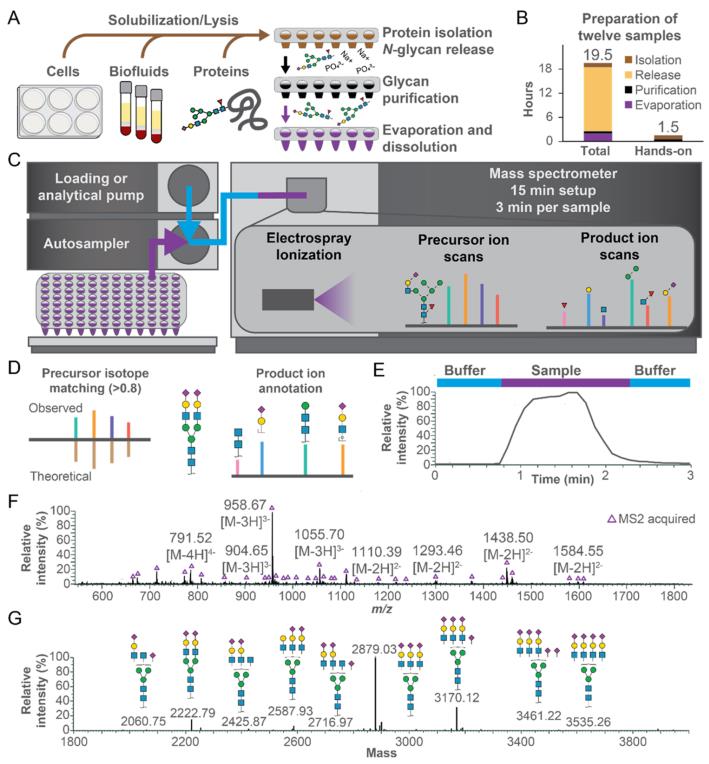
Fig. 1 Overview of Swift Universal Glycan Acquisition (SUGA) by Data Dependent Acquisition Mass Spectrometry (DDA-MS) method. (A) Sample preparation workflow was used to obtain N-glycans for SUGA. (B) Duration of the sample preparation steps. (C) Instrument setup for automated sample injection and data acquisition. (D) Criteria used for high-confidence glycan identification. Native bovine fetuin N-glycans were analyzed by SUGA. (E) Total Ion Chromatogram (TIC). (F) Negative mode precursor ion mass spectrum with monoisotopic masses and ions subjected to fragmentation labeled. (G) Charge deconvoluted precursor ion mass spectrum with the corresponding glycan identifications. (Ashwood, et al. 2025)
- Cell/Protein Sample
- PNGase-F Glycan Release
- Carbon Solid-Phase Extraction Purification
- Dissolved in 0.1% Piperidine Aqueous Solution
- Direct Injection to Orbitrap Fusion Lumos MS
- 3-minute DDA-MS acquisition (negative ion mode)
- Data deconvolution and MS2 annotation
- Glycan composition identification and quantification (Skyline software)
Comparison and Validation of SUGA with MALDI-TOF
To verify the reliability of SUGA, the research team systematically compared it with the currently widely accepted gold standard for glycan analysis (MALDI-TOF MS Analysis after methylation derivatization).
The researchers selected five purified glycoproteins with different types of N-glycans (high-mannose type, complex neutral type, and complex sialylated type). The same released glycan sample was divided into two portions: one was analyzed using SUGA for natural glycans, and the other was methylated and then analyzed using both SUGA and MALDI-TOF.
The results showed:
- Highly consistent spectra: For all tested proteins, the deconvoluted relative abundance spectra obtained from SUGA analysis of methylated glycans were almost identical to the MALDI-TOF spectra, demonstrating the accuracy of SUGA in quantitative analysis.
- Reliability: The complete methylation reaction efficiency was >93%, verifying the reliability of the method.
- Superior fragmentation information: In terms of obtaining secondary fragmentation spectra, SUGA (whether analyzing natural or methylated glycans), due to its ability to produce multiply charged precursor ions, typically yields spectra with more informative fragment ions from collision-induced dissociation than MALDI-TOF MS/MS, which helps in more accurate identification.
Technical Reproducibility and Sample Volume Optimization
For direct injection, a separation-free method, concerns naturally arise regarding its technical reproducibility. Researchers evaluated the variability of SUGA by performing five replicate experiments using ExpiCHO cell lysate.
Within a dynamic range of 2.5 orders of magnitude, only 2 of the 58 detected glycan compositions had a CV greater than 20%, with a median CV of approximately 10%. The coefficient of variation was negatively correlated with the signal intensity of the glycans, meaning that stronger signals resulted in better reproducibility.
Simultaneously, the study investigated the impact of the initial protein amount on the results. It was found that when the initial protein amount was below 50 μg, not only did the glycan signal intensity decrease, but the CV of some low-abundance glycans increased, and even the abundance ranking of glycan compositions began to be distorted. Therefore, it is recommended to use at least 50 μg of initial protein for glycan release to ensure data stability.
Application of SUGA in Glycosylation Inhibitor Screening
To demonstrate SUGA's powerful capabilities in high-throughput, quantitative analysis, researchers applied it to unbiased screening of Glycosylation Inhibitors.
They treated ExpiCHO cells with three inhibitors with different mechanisms of action:
- Castanospermine: Inhibits α-glucosidase. SUGA data clearly showed a significant accumulation of mono- and di-glucosylated high-mannose type glycans after treatment, which was entirely consistent with expectations.
- Kifunensine: Inhibits α1,2-mannosidase. As expected, several high-mannose type glycans significantly increased, while some complex type glycans decreased, revealing the dynamic reprogramming of the host cell glycosylation machinery under perturbation.
- Swainsonine: Inhibits α1,3/6-mannosidase. SUGA not only detected the expected changes in High-mannose Type Glycans but also discovered the generation and accumulation of new hybrid type glycans. Time-course experiments further revealed that hybrid type glycans with different degrees of sialylation reached steady state at different time points, precisely demonstrating the dynamic process of drug action.
These experiments demonstrate that SUGA can unbiasedly capture changes in glycan composition and reveal the temporal dynamics of different inhibitor actions, providing a powerful tool for glycosylation pathway research.
Limitations and Prospects of SUGA
Of course, the SUGA method currently has its limitations:
- Isomer differentiation: The current method primarily provides information on glycan composition and cannot directly distinguish certain isomers, such as the linkage type of sialic acid (α2,3 vs α2,6).
- Scope of application: The current workflow is optimized for N-glycans. Although it is possible to extend it to the analysis of O-glycans, Glycosaminoglycans, and Glycolipids by changing the release and purification methods in the future.
Nevertheless, SUGA has broad prospects. It provides an elegant and powerful solution to address the high-throughput bottleneck in glycomics. With further optimization and popularization of the method, it is expected to:
- Promote glycomics research in large-scale clinical cohorts and discover new disease biomarkers.
- Accelerate the screening and development process of glycosylation-related drugs.
- Become a rapid tool for monitoring the quality of glycoprotein products in cell engineering and biopharmaceuticals.
Conclusion
The emergence of the SUGA method represents a significant innovation in the field of glycomics analysis. It reduces the analysis time for a single sample from hours to minutes, achieving a leap in throughput while maintaining data quality.
Through direct analysis without derivatization, SUGA not only simplifies the process and increases speed but also reduces potential interference with fragile glycan structures. Its high consistency with the gold standard method and its powerful quantitative capabilities demonstrated in high-throughput inhibitor screening fully prove its reliability, robustness, and practicality.
As the role of glycobiology in life and health and disease treatment becomes increasingly prominent, efficient and agile analytical tools like SUGA will undoubtedly become a key tool for researchers to unlock the mysteries of glycobiology, driving the entire field to develop rapidly in greater depth and breadth.
Related Services & Products
- Custom Glycosylation of Proteins
- Custom Glycosylation of Antibodies
- Custom Glycosylation of Cell Membranes
- Custom Glycosylation of Bacteria Membranes
- Glycan Structure Analysis
- Glycoprotein Structure Analysis
- Glycan Release Service
- Glycan Separation and Purification Service
- Glycan Derivation Service
- Glycomic Characterization Service
- Glycomic Quantitation
- Flow Cytometry Profiling
- Cyclodextrin
- Glycolipids
- Glycosaminoglycans
- N-Glycan
- O-Glycan
Reference
- Ashwood, C., et al. (2025). Swift Universal Glycan Acquisition (SUGA) Enables Quantitative Glycan Profiling across Diverse Sample Types. Journal of Proteome Research, 24(3), 1030-1038. DOI: 1021/acs.jproteome.4c00657.


