Custom Hybrid DNA Synthesis Service
Importance of DNA Nanotechnology
DNA, which contains repetitive functional residues, acts as the genetic code for the survival of all living beings on the earth. It has gradually been recognized as a polymeric nanostructure. Nucleic acid nanotechnology aims to create nanoscale objects, materials, and devices by folding and combining DNA or RNA components. DNA nanotechnology is useful in many areas, including fundamental biology, academic and industrial fields. With the rapid advancement of structural transformations, structural DNAs have been assembled into various forms, such as X- or Y-shaped DNAs.
Due to their unique characteristics, such as superior electromagnetics and inherent biocompatibility, inorganic nanomaterials have long been used for biological purposes. To use them within the cytosol, it is necessary to reduce their size. Using structural DNA nanomaterials has significantly improved the ability to employ inorganic compounds.
Key Technologies
Our service is founded on the principle of directed self-assembly, where custom-synthesized DNA oligonucleotides are meticulously conjugated to nanoparticles to create functional hybrid structures. This process leverages the inherent base-pairing properties of DNA to direct the precise spatial arrangement of the nanomaterials. We employ specialized surface chemistries and linkers to ensure stable and covalent attachment of DNA strands to the nanoparticle surface. This allows for the creation of robust and highly specific DNA-nanomaterial conjugates with predictable architectures, enabling diverse applications that demand high precision and reliability. Our approach ensures a uniform, high-quality product ready for immediate use.
One Sequence, Two Technologies: Unlimited Possibilities.
Hybrid materials made of structural DNAs and inorganic compounds show significant progress in various cutting-edge applications, including biological uses. Therefore, CD BioGlyco has developed various technologies for the synthesis of various hybrid materials made of structural DNAs and inorganics. Those hybrids have potential as future material substitutes for some practical bio-applications.
DNA-gold nanomaterial hybrid
- We combine two different gold nanomaterials with DNA origami in a synergetic manner. The DNA strand is employed as a template for DNA origami. A capture strand is then extended from the origami and specifically combined with complementary strands embedded on the surface of gold nanorods.
- The hybrid of gold nanorods and DNA origami has shown great potential as contrast agents for optoacoustic imaging. These hybrids are ideal for in vivo applications because they provide better resolution quality, even with lower doses.
- Additionally, these hybrids function as photothermal therapy agents. When exposed to NIR irradiation, they effectively inhibit tumor regrowth and prolong the survival of diseased mice.
Agarose gel is utilized to purify the hybrids. We employ a freeze-squeeze column technique to slice and extract the target products from the gel. The transmission electron microscope (TEM) and the ultraviolet-visible (UV-vis) spectrometer are utilized for the characterization of the purified nanostructures.
DNA-magnetic nanoparticle hybrid
Iron oxide nanoparticles have gained significant attention in various practical applications due to their super-paramagnetism in magnetic fields. We offer an approach for arraying magnetic nanoparticles on the surface of DNA nanotubes. The positioning of magnetic nanoparticles on the outer surface of DNA nanotubes is achieved through the self-assembly of polynucleotide staples using an origami process. To arrange the staples on the surface of DNA nanotubes, we use a biotin labeling technique to selectively label some of the staples.
These hybrids have the potential to arrange multiple nanoparticles. They are valuable as functionalized chimeric nanocarriers for the development of innovative nanodrugs and nano biosensors.
DNA-silver nanomaterial hybrid
Compared to gold nanoparticles of the same size, silver nanoparticles exhibit higher extinction coefficients. They are more suitable for plasmonic applications such as enhanced Raman scattering. Conversely, silver nanoparticles have lower Ag-S bond energy compared to Au-S, making it more challenging to conjugate them with monothiol-modified DNA. Additionally, silver nanoparticles are more susceptible to oxidation in nanoparticle form and have a tendency toward irreversible aggregation. We link monothiol-modified DNA to silver nanoparticles which surmounts problems associated with adsorption kinetics at neutral or slightly basic pH. DNA-silver nanomaterial hybrid can be used in DNA detection through sandwich assays and electrochemical detection methods.
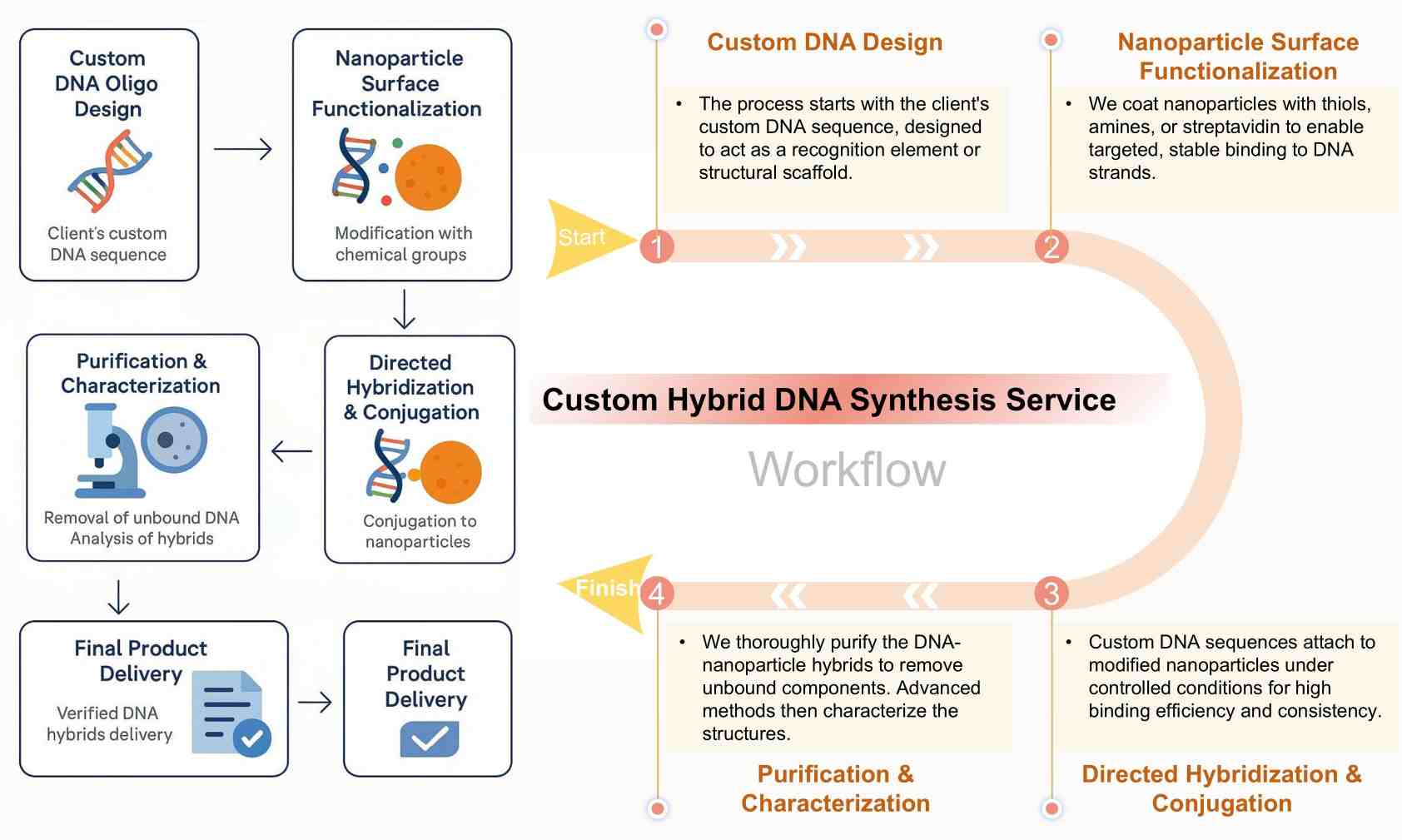
Workflow
- Custom DNA Design
The process begins with the client's custom DNA sequence, which is designed to function as a specific recognition element and/or a structural scaffold.
- Nanoparticle Surface Functionalization
We prepare the desired nanoparticles by modifying their surfaces with specific chemical groups, such as thiols, amines, or streptavidin, to allow for stable and directed coupling with the DNA oligonucleotides.
- Directed Hybridization & Conjugation
The custom DNA sequences are then conjugated to the functionalized nanoparticles under controlled conditions, ensuring a high degree of binding efficiency and uniformity. For example, a biotinylated oligonucleotide probe can be conjugated with streptavidin-modified nanoparticles.
- Purification & Characterization
The resulting DNA-nanomaterial hybrids are rigorously purified to remove any unbound DNA or nanoparticles. We then use a range of advanced analytical techniques, including transmission electron microscopy (TEM) and complex magnetization measurements, to characterize the hybrid structures, confirming their size, morphology, and conjugation efficiency.
- Final Product Delivery
The verified and quality-controlled DNA hybrids are delivered to the client, accompanied by a comprehensive technical report detailing the synthesis parameters and characterization data.
Publication Data
DOI.: 10.1186/s40580-019-0211-4
Journal: Nano Convergence
IF: 11.0
Published: 2020
Results: This panoramic critique examines conjugations of architectured DNA nanotechnology with inorganic species, including gold, iron oxide, quantum dots, upconversion nanoparticles, and carbon nanotubes, forging hybrid constructs for sophisticated biomedicine. They dissect how nucleic acid frameworks such as multi-arm junctions, folded lattices, and hollow cylinders act as programmable molecular pegboards that orchestrate inorganic components with Ångström-level precision to elicit cooperative functional augmentations. Paramount implementations encompass precision pharmacotherapy delivery, plasmonic hyperthermia treatments, high-definition biomolecular visualization - particularly NIR-II spectral tomography using nanotubular carbon - alongside affinity biosensors. These chimeric systems exploit DNA's innate biological tolerability while mitigating constituent frailties, namely quantum dot photodegradation and tissue-penetration depth constraints. Landmark innovations, including optoacoustic contrast agents and stimulus-actuated therapeutic nanoassemblies, are foregrounded, with concomitant emphasis on uncharted diagnostic and interventional potentialities within pathological contexts.
Applications
- DNA-gold nanomaterial hybrids can be used in nucleic acid detection, colorimetric detection of miscellaneous analytes, and non-covalent gene delivery.
- Furthermore, DNA-gold nanomaterial hybrids have been covalently attached to anti-cancer drugs and are employed as carriers for drug delivery purposes.
- DNA-magnetic nanoparticle hybrids act as valuable tools for the development of innovative nanodrugs and nano biosensors.
- DNA-silver nanomaterial hybrid can be used for the detection of small molecules and as a DNA sensor with detection.
Advantages
- Our DNA hybrids combine the benefits of DNA nanostructures and inorganic nanomaterials, presenting high potential in various fields.
- Our method possesses simplicity and programmability and constructs a functional nanoarray of magnetic nanoparticles on the surface of DNA templates.
- We initiate an active area of research that encompasses both fundamental scientific investigations into intrinsic properties and practical applications.
Frequently Asked Questions
Associated Services
We deliver high-fidelity, complex DNA constructs for gene editing and synthetic biology applications. To maximize the functional adaptability of these sequences, enabling precise conjugation, labeling, or immobilization, we offer Oligonucleotide-based Linker Modification Services. These targeted modifications engineer site-specific handles for downstream integration:
- Amino-based Oligonucleotide Modification Service
- Biotin-based Oligonucleotide Modification Service
- Thiol-based Oligonucleotide Modification Service
- Alkyne-based Oligonucleotide Modification Service
- Azide-based Oligonucleotide Modification Service
- Adenylation-based Oligonucleotide Modification Service
- Digoxigenin-based Oligonucleotide Modification Service
CD BioGlyco is a highly topping company in the field of glycobiology. We are widely recognized for exceptional proficiency in Custom DNA Synthesis Service. Our company is confident in our extensive knowledge in this field. With an experienced team, we offer a comprehensive range of services to meet the unique requirements of our clients. If you would like to know more about our services, please feel free to contact us for further information.
Reference
- Shin, S.W.; et al. Hybrid material of structural DNA with inorganic compound: synthesis, applications, and perspective. Nano Convergence. 2020, 7(1): 2. (Open Access)
Quick Links
Resources
- Glyco™ Synthesis Platform
- Custom Glycoprotein Synthesis
- Custom Glycoside Synthesis
- Custom Glycosyl Donor Synthesis
- Custom Thioglycoside Synthesis
- Custom Phosphatidylinositol Synthesis
- Custom Cyclodextrin Synthesis
- Custom Rhamnolipid Synthesis
- Custom Sphingolipid Synthesis
- Custom Building Block Synthesis
- Carbohydrate Manufacturing
- Synthesis Process Development and Optimization
- Custom Carbohydrate Synthesis
- Custom Glycolipid Synthesis
- Custom Glycopeptide Synthesis
- Custom Glycoconjugate Synthesis
- Custom Sugar-Nucleotide Synthesis
- Nucleoside & Nucleotide Synthesis Service
- Custom Oligonucleotide Synthesis Service
- Polynucleotide Synthesis Service
- Nucleoside & Nucleotide Modification Service
- Oligonucleotide Modification Service
- Nucleoside-based Production Service
- Nucleotide-based Production Service
- OPME-based NDP-sugar Synthesis Service
- OPME-based NMP-sugar Synthesis Service
- Glycomics Platform
- Glycoproteomics Platform
- N-Glycoproteomics of PDX Models
- Nanotechnologies for the Detection of Glycopeptides
- Glycoprotein Enrichment
- Glycoprotein Quantification
- Glyco-biomarker Detection Service
- Glyco-biomarker AFP Detection Service
- Glyco-biomarker CA19-9 Detection Service
- Glyco-biomarker CA125 Detection Service
- Glyco-biomarker CA15–3 Detection Service
- Glyco-biomarker CEA Detection Service
- Glyco-biomarker PSA Detection Service
- Glyco-biomarker Immunoglobulin G (IgG) Detection Service
- Glyco-biomarker Haptoglobin (Hp) Detection Service
- Glyco-biomarker α1-Antitrypsin (A1AT) Detection Service
- Glyco-biomarker α1-Acid Glycoprotein (AGP) Detection Service
- Glyco-biomarker Ceruloplasmin (CP) Detection Service
- Glyco-biomarker Fetuin A Detection Service
- Site Occupation
- Glycoprotein Structure Analysis
- Glycosylation Site-specific Antibody-Drug Conjugate (ADC) Development Platform
- Carbohydrate-based Glycomedicine Development Platform
- By Sources of Carbohydrate
- By Types of Carbohydrate
- Monosaccharides-based Glycomedicine Development
- Disaccharides-based Glycomedicine Development
- Trisaccharides-based Glycomedicine Development
- Oligosaccharides-based Glycomedicine Development
- Polysaccharides-based Glycomedicine Development
- Glycosides-based Glycomedicine Development
- Glycopeptide-based Glycomedicine Development
- Glycomimetic-based Glycomedicine Development
- By Applications of-based Glycomedicines
- Carbohydrate-based Anticoagulant Glycomedicine Development
- Carbohydrate-based Cardiovascular Glycomedicine Development
- Carbohydrate-based Antitumor Glycomedicine Development
- Carbohydrate-based Antidiabetic Glycomedicine Development
- Carbohydrate-based Antibacterial Glycomedicine Development
- Carbohydrate-based Antiviral Glycomedicines Development
- Carbohydrate-based Antiparasiti Glycomedicine Development
- By Discovery Strategies
- Glycoengineering-based Glycomedicine Development
- Production of Food Ingredients
- Multi-omics Platform for Cancer Glucose Metabolism (MOPCGM)
- Cancer Cell Glycolytic Analysis
- Cancer Cell TCA Cycle Analysis
- Cancer Cell PPP Analysis
- Gene-level Regulation Analysis of Cancer Glucose Metabolism
- Interplay Between Glucose Metabolism Reprogramming and Tumorigenesis & Progression
- Interplay Between Glucose Metabolism Reprogramming and Proliferative Signaling
- Interplay Between Glucose Metabolism Reprogramming and Growth Suppressor
- Interplay Between Glucose Metabolism Reprogramming and Cancer Cell Death
- Interplay Between Glucose Metabolism Reprogramming and Replicative Immortality
- Interplay Between Glucose Metabolism Reprogramming and Angiogenesis
- Interplay Between Glucose Metabolism Reprogramming and Invasion & Metastasis
- Interplay Between Glucose Metabolism Reprogramming and Immune Escape
- Interplay Between Glucose Metabolism Reprogramming and Genomic Instability
- Interplay Between Glucose Metabolism Reprogramming and Tumor-associated Inflammation
- Glucose Metabolism-Microenvironment Crosstalk Analysis in Cancer
- Cancer Glucose Metabolism In Vivo Analysis
- Applications of Studing Cancer Glucose Metabolism
- Discovery of Cancer Glucose Metabolism Small Molecule Inhibitor
- Discovery of Cancer Glucose Metabolism Therapeutic Monoclonal Antibodies
- Development of Gene Therapy Targeting Cancer Glucose Metabolism
- Discovery of Cancer Glucose Metabolism CAR-T Therapy Targeting
- Discovery of Cancer Glucose Metabolism Combination Therapy Strategy
- Discovery of Cancer Glucose Metabolism Precision Therapeutic Strategies
- Glycoengineering Platform
- Therapeutic Nucleic Acid Development Platform
- Therapeutic Oligonucleotide Synthesis Service
- siRNA Synthesis
- miRNA Synthesis
- ASO Synthesis
- Aptamer Synthesis
- PMO Synthesis
- sgRNA Synthesis
- Circular RNA Synthesis
- PNA Synthesis
- Lipid-based GalNac-RNA Delivery Service
- CpG Oligonucleotide Synthesis
- Click-based GalNac-RNA Delivery Service
- AntimiR Synthesis
- GalNAc-siRNA Delivery Service
- tRNA Synthesis
- GalNAc-ASO Delivery Service
- saRNA Synthesis
- Reporter Gene mRNA Synthesis
- Gene Editing mRNA Synthesis
- Gene Replacement mRNA Synthesis
- Cre Recombinase mRNA Synthesis
- hEPO mRNA Synthesis
- OVA mRNA Synthesis
- Therapeutic Oligonucleotide Modification Service
- Therapeutic Oligonucleotide Delivery Development Service
- Targeted Ligand and Linker Synthesis
- Monoantennary GalNac-RNA Delivery
- Biantennary GalNac-RNA Delivery
- Triantennary GalNac-RNA Delivery
- Tetra-antennary GalNac-RNA Delivery
- Solution Phase-based GalNac-RNA Delivery
- Solid Phase-based GalNac-RNA Delivery
- mRNA Poly(A) Tail Length Analysis
- GalNAc-siRNA Delivery
- GalNAc-ASO Delivery
- GalNAc-miRNA Delivery
- GalNAc-Aptamer Delivery
- GalNAc-AntimiR Delivery
- GalNAc-mRNA Delivery
- GalNAc-PNA Delivery
- Peptide-Therapeutic Oligonucleotide Delivery
- LNP-Therapeutic Oligonucleotide Delivery
- PEG-Therapeutic Oligonucleotide Delivery
- Biological Evaluation Service for Therapeutic Oligonucleotide
- mRNA-based Vaccine Development Service
- mRNA Sequence Design&Optimization Service
- mRNA Integrity Analysis ServicemRNA Integrity Analysis Service
- mRNA Biodistribution Analysis Service
- DNA Template Preparation Service
- mRNA Purity Analysis Service
- T Cell Cytokine Secretion Analysis Service
- mRNA Modification Service
- mRNA Length Analysis Service
- mRNA Purification Service
- Neutralizing Antibody Assay Service
- mRNA-LNP Formulation and Encapsulation Service
- mRNA Structural Characterization
- mRNA Structural Characterization Service
- mRNA Bioanalysis Service
- mRNA Residual DNA Template Analysis Service
- mRNA Residual Double-Stranded RNA (dsRNA) Analysis Service
- mRNA Size Analysis Service
- mRNA Polydispersity Analysis Service
- mRNA Zeta Potential Analysis Service
- mRNA Lipid Composition Analysis Service
- Oligonucleotide Drug Process and Formulation Development Service
- RNA Drug Process and Formulation Development
- Therapeutic Oligonucleotide Synthesis Service
- Glycobiology Microarray Platform
- Glyco™ Vaccine Development Platform
- Carbohydrate-based Vaccine Development
- Polysaccharide Vaccine Development
- Tumor-Associated Carbohydrate Vaccine Development
- Glycoconjugate Vaccine Development
- Natural Carbohydrate-based Vaccine Development
- Semi-synthetic Carbohydrate-based Vaccine Development
- Fully Synthetic Carbohydrate-based Vaccine Development
- Carbohydrate-based Antibacterial Vaccine Development
- Carbohydrate-based Antifungal Vaccine Development
- Carbohydrate-based Antiparasitic Vaccine Development
- Carbohydrate-based Antiviral Vaccine Development
- Carbohydrate-based Anticancer Vaccine Development
- Carbohydrate-based Antihelmintic Vaccine Development
- Monovalent Carbohydrate-based Vaccine Development
- Polyvalent Carbohydrate-based Vaccine Development
- Carrier Protein Design Service
- Carbohydrate Conjugation Service for Vaccine Development
- Carbohydrate-based Adjuvant Development
- Lipopolysaccharide-based Adjuvant Development
- Bacterial Outer Membrane Vesicles (OMVs)-based Adjuvant Development
- Trehalose Glycolipid-based Adjuvant Development
- Galactosylceramide-based Adjuvant Development
- Peptidoglycan-based Adjuvant Development
- Chitin/Chitosan-based Adjuvant Development
- Inulin-based Adjuvant Development
- Mannans-based Adjuvant Development
- Alginate-based Adjuvant Development
- Saponin-based Adjuvant Development
- α-Glucan-based Adjuvant Development
- Lentinan-based Adjuvant Development
- β-Glucans-based Adjuvant Development
- Deltin-based Adjuvant Development
- Muramyldipeptide-based Adjuvant Development
- Cord Factor-based Adjuvant Development
- Zwitterionic Polysaccharide-based Adjuvant Development
- Novel Plant Polysaccharides-based Adjuvant Development
- Glycoprotein-based Vaccine Development
- Glycopeptide-based Vaccine Development
- Carbohydrate-based Vaccine Development
- Glycogenomics Platform
- Glycogene Editing Service
- Glycogene Delivery Service
- Glycogene Expression Profiling
- Cancer Glycogene Discovery Service
- Glycogene Discovery Service in Cervical Cancer
- Glycogene Discovery Service in Leukemia
- Glycogene Discovery Service in Bladder Cancer
- Glycogene Discovery Service in Colorectal Adenocarcinoma
- Glycogene Discovery Service in Liver Cancer
- Glycogene Discovery Service in Lymphoma
- Glycogene Discovery Service in Breast Cancer
- Glycogene Discovery Service in Prostate Cancer
- Glycogene Discovery Service in Pancreatic Cancer
- Glycogene Discovery Service in Lung Cancer
- Glycogene Discovery Service in Thyroid Cancer
- Glycogene Discovery Service in Ovarian Cancer
- Glycan Display Platform
- Traditional Glycan Display Array
- Natural Oligosaccharide Library Construction Service
- Chemical Synthesis-based Oligosaccharide Library Construction Service
- Enzymatic Synthesis-based Oligosaccharide Library Construction Service
- Modular Synthesis-based Oligosaccharide Library Construction Service
- Oligosaccharide Library Immobilization Service
- Cell-based Glycan Display Array
- Neoglycolipid (NGL) Display Array
- Liquid Glycan Display Array (LiGA)
- Glycophage Display
- N-linked Glycoprotein-based Glycophage Display System Construction Service
- O-linked Glycoprotein-based Glycophage Display System Construction Service
- Glycophage Display-based Glycosylase Genetic Analysis Service
- Glycophag Display-based Glycoarray Service
- Glycophage Display-based Antibody Development Service
- Glycophage Display-based Epitope Mapping Service
- Glycophage Display-based Biomarker Development Service
- De Novo Glycan Display
- Cell-Surface Glycan Editing
- Examining the Effects of Altering Blood Group Antigens on Erythrocyte Cell Surfaces
- Preventing Cellular Rejection During Transplantation
- Modulating Chemical Composition and Physical Parameters of Glycocalyx
- Tailoring Cell Membranes with Biologically Active Glycans
- Targeting Glycosaminoglycan-mediated Growth Factor Signaling to Influence Stem Cell Specification
- Long-term De Novo Glycan Display for Directing Stem Cell Fate
- Traditional Glycan Display Array
- GlycoNano™ Platform
- Glyconanoparticle Development Service
- Techniques for Glyconanoparticle Development
- Carbohydrate-based Nanoparticle Production
- Gold Glyconanoparticle Production
- Silver Glyconanoparticle
- Magnetic Glyconanoparticle
- Quantum Dot (QD) Glyconanoparticle
- Glyconanoparticle Characterization
- PEG Glyconanoparticle
- Carbon-based Glyconanoparticle
- Fluorescent Glyconanoparticle
- Silica Glyconanoparticle
- Liposome Glyconanoparticle
- Glycol Nanohydrogel Development
- Glycol Nanorod
- Glycol Nanotube
- Glycol Nanocrystal/Nanosheet/Nanosphere/Nanofiber
- Glyconanoparticle Preclinical Study
- Glyconanoparticle Formulation
- Glyconanotechnology-based Biosensor Development
- GlycoNano™ Bioink Production for 3D Printing
- Glyconanoparticle Development Service
- Glyco™ Synthesis Platform


